


EU project improves sound generation, transfer and reproduction
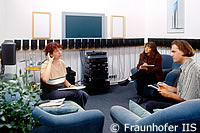
An EU project addressing high quality sound transfer is preparing to present its first set of results at the International Funkausstellung (IFA), an exhibition of electronic entertainment, communications and information products, taking place in Berlin, Germany on 25 August to 2 September. The project is known as CARROUSO (creating, assessing and rendering in real-time of high quality audiovisual environments in MPET-4 context) and is funded under the IST (Information society technologies) programme from the European Commission's Fifth Framework programme. Work began on 1 January 2001 and will continue until June 2003. The aim of the project is to develop and implement the key components for recording, transmission, encoding, decoding and rendering audio signals 'People should be able to experience the surround sound they know from movie theatres in the comfort of their living room,' said Dr Thomas Sporer, project coordinator from the Fraunhofer Institut. 'Numerous theories and techniques have been developed in the past, but none of them proved suitable for practical implementation.' Specifically, the project will focus on: - specification, development, implementation and validation of a new technology that enables the transfer of a sound field, generated in a real or virtual space, to another usually remote located space; - specification, development, implementation and validation of new modelling, recording, encoding, decoding and rendering techniques for audio signals enabling the above technology; - building a real time demonstrator for the technology; - defining and monitoring performance levels of the technology in perceptual experiments using the demonstrator. The project partners, from the audio, multimedia and telecoms fields in five European countries, are seeking to overcome several constraints present in commercial multi channel sound systems, namely the instability of stereophonic quality and the practical limitations of sound production by two-channel stereo, five-channel surround or conventional sound systems. The project is also working on combining the audio reproduction technology with moving pictures. This technology has got rid of the scenario where music can best be heard from just one position, said Dr Sporer. 'No matter where listeners position themselves, they always experience the sensation of sitting in one of the best seats.' Assessing the possible applications for the developed CARROUSO tool, the project consortium asked various experts for their opinions. Some 14 different applications were suggested, which were divided by the project participants into three groups: spatial, audio and video theatre; auralisation; and communication. For the first category, CARROUSO could be used to generate high quality sound for the general public in the cinema and during cultural and sports transmissions. Data would be transmitted over broadcast-oriented networks that preserve the original quality. The second set of applications, auralisation, concerns the provision of sound for simulators, games, noise forecast, and 3D rehearsal. The technology should provide a realistic rendering of the audiovisual scene with a very high quality audio room effect. The users in this context will be the general public, industrial companies, the army, music companies and leisure parks. CARROUSO could also be used to increase the presence sensation of remote talkers during teleconferences and videoconferences. 3D audio will enable the listener to isolate the speaker of interest from background talk. Users would be predominantly professionals in this context, but the tool could appear attractive to domestic applications using the Internet, such as Voice Chat.