


Head of Eureka secretariat calls for restructuring of network in response to change
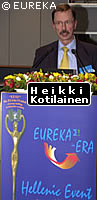
The outgoing head of the Eureka secretariat has called for a reorganisation of the organisation in order to enhance industrial cooperation, thus contributing to the Barcelona goal of increasing research investment in Europe to three per cent of GDP. Eureka is a European network for market-oriented research and development (R&D), which aims to strengthen European competitiveness through collaborative research. In his final editorial for Eureka's quarterly newsletter, Heikki Kotilainen argues that only cooperation between industry and mechanisms such as Eureka will enable Europe to reach its three per cent objective, but that Eureka's present status as a 'non-institution' makes it unable to play a dynamic role. 'In order to play a role in the ERA [European Research Area] and in the global competitive environment, Eureka must adapt itself in response to change. Having grown to 34 members with still more countries to join, the current organisational model has become obsolete. [...] A more business-like approach will be needed, principally by bringing industry closer to the decision-making process,' writes Mr Kotilainen. Among Mr Kotilainen's suggestions for the restructuring of Eureka are: the replacement of the rotating chairmanship system with a hosting system, possibly the Commission or an EU chair country; the establishment of an executive secretariat; the provision of synchronised funding, including via the European Investment Bank; the establishment of an executive board with members from industry; the allocation of clear accountabilities and the streamlining of decision making. Mr Kotilainen highlights a paradox in Eureka: 'Despite its bottom-up and de-centralised approach, national funding organisations are not adequately represented in meetings where projects are discussed for endorsement. [...] As a consequence, there is clear evidence that national commitment in favour of Eureka is not as strong as it should be.' The editorial also claims that the weakness in Eureka's organisation has also led to a lack of policy and strategy.