Planetarium of new techniques in radio astronomy

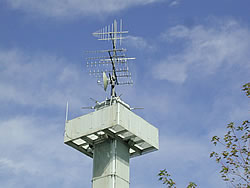
Radio waves can overcome all those elements such as dust or gases that block our view in visible light When combined with interferometry radio waves can help us solve long-distance cosmic mysteries. Interferometry takes signals from two or more separate telescope antennas that are tuned to receive radio emissions from a source in a desired RF band. The signals received are then cross-correlated (multiplied and accumulated) to produce a result ranging from an image of a distant astronomical object to the precise location of a nearby terrestrial or extraterrestrial radio emitter. In essence, interferometry allows the creation of a single telescope with an aperture as large as the distance between the two antennas. By assembling any number of antennas into so-called arrays, scientists can virtually build a telescope any size they wish. If antennas are separated by long distances Very Long Baseline Interferometry – VLBI, then the signals are recorded on magnetic tape and the tapes are shipped to the correlator for processing at a convenient time. A research group introduced new techniques such as multiple field centre correlation and cluster-cluster technique, in order to enhance an astronomers’ capabilities. Multiple field centre correlation allows a significant increase in the amount of astronomical information which can be extracted from a given VLBI observation. The gain is achieved by processing the image within the primary beam of the largest radio telescope involved in the VLBI observation. The Cluster-Cluster (Cl-Cl) or multiview VLBI technique is a development to the observational capabilities of VLBI, where single telescopes are replaced by sites with multiple antenna elements (a “cluster”) fed from a common local oscillator. Cl-Cl mode reduces many common VLBI errors (clock and oscillator drifts) between the long baselines and eliminates the unknown contributions to the signal paths caused by the atmosphere and troposphere. New techniques, their application and sub products (i.e. software code) open up new possibilities in astronomy studies and discoveries of quasars, pulsars and black holes.