Anthropogenic influence to Plitvice Lakes, Croatia

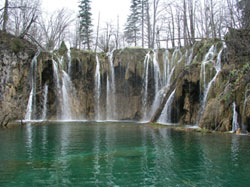
The Plitvice Lakes are series of 16 lakes, tufa barriers and waterfalls located in the Dinaric Karst of Central Croatia. The area was proclaimed as a National Park 60 years ago and was included into the UNESCO World Heritage List. In this complex aquatic system calcium carbonate precipitates very intensively in presence of macrophites and microphites forming numerous tufa barriers and lake sediments. In the last decades the process of eutrophication in the Plitvice Lakes has been observed in the form of intense plant growth. Whether this process is a consequence of anthropogenic pollution or due to naturally produced organic matter in the lakes was investigated. The results of physico-chemical measurements of water show that temperature, pH, alkalinity, and saturation index of CaCO3, change significantly in downstream flow and have seasonal variations. Trace elements and nutrients do not indicate recent anthropogenic pollution, although the concentrations of dissolved organic carbon and nutrients are slightly higher in the area of increased eutrophication-plant growth. Delta13C values and 14C activity of dissolved inorganic carbon steadily increase downstream showing that carbon exchange process plays an important role for tufa precipitation. Lake sediments consist prevalently of calcite with different content of organic matter, the highest being at sites with the highest C/N ratio indicating its terrestrial origin. Trace element and organic matter content in sediments decreases in downstream direction. The sedimentation rate determined by 137Cs and 210Pb is higher in smaller lakes. The peak 14C activity as the consequence of nuclear experiments in the atmosphere was observed. Increased delta13C in topmost layers of some sediments was attributed to the increase of primary productivity in the lakes that enhanced the biologically induced calcite precipitation. Smaller lakes respond faster to local environmental changes, while the global contamination was reflected in the whole system. No indication of recent anthropogenic pollution in water and sediment was found, but some influence of input of natural organic matter to lakes was observed. The results are useful for local authorities, enterprises and non-governmental organizations and can assist in promoting of reestablishment of sustainable development of the region. Figure caption: Fig.1: Waterfalls in Plitvice Lakes National Park